I built a system of 8 AI specialists — one for each major domain of my life — to remove the invisible mental load blocking me from the work only I can do. This is the architecture, the decisions, and what it actually produced.
January 2025. My dad navigating memory loss, alone since my mom passed in April 2024. A tween. A full house mid-renovation, walls open, no kitchen. A career restart attempt after 12 years out of corporate. A creative brand I wanted to build from scratch. All running simultaneously, with no team, no support structure, no buffer.
Overstimulated. Overwhelmed. Decision fatigue stacked on top of more decisions. The invisible load was already full — and I still had creative work that actually needed me.
The question I asked in January 2025: What if AI could take on the tasks I have to do, so I can protect the time and energy for the work only I can do?
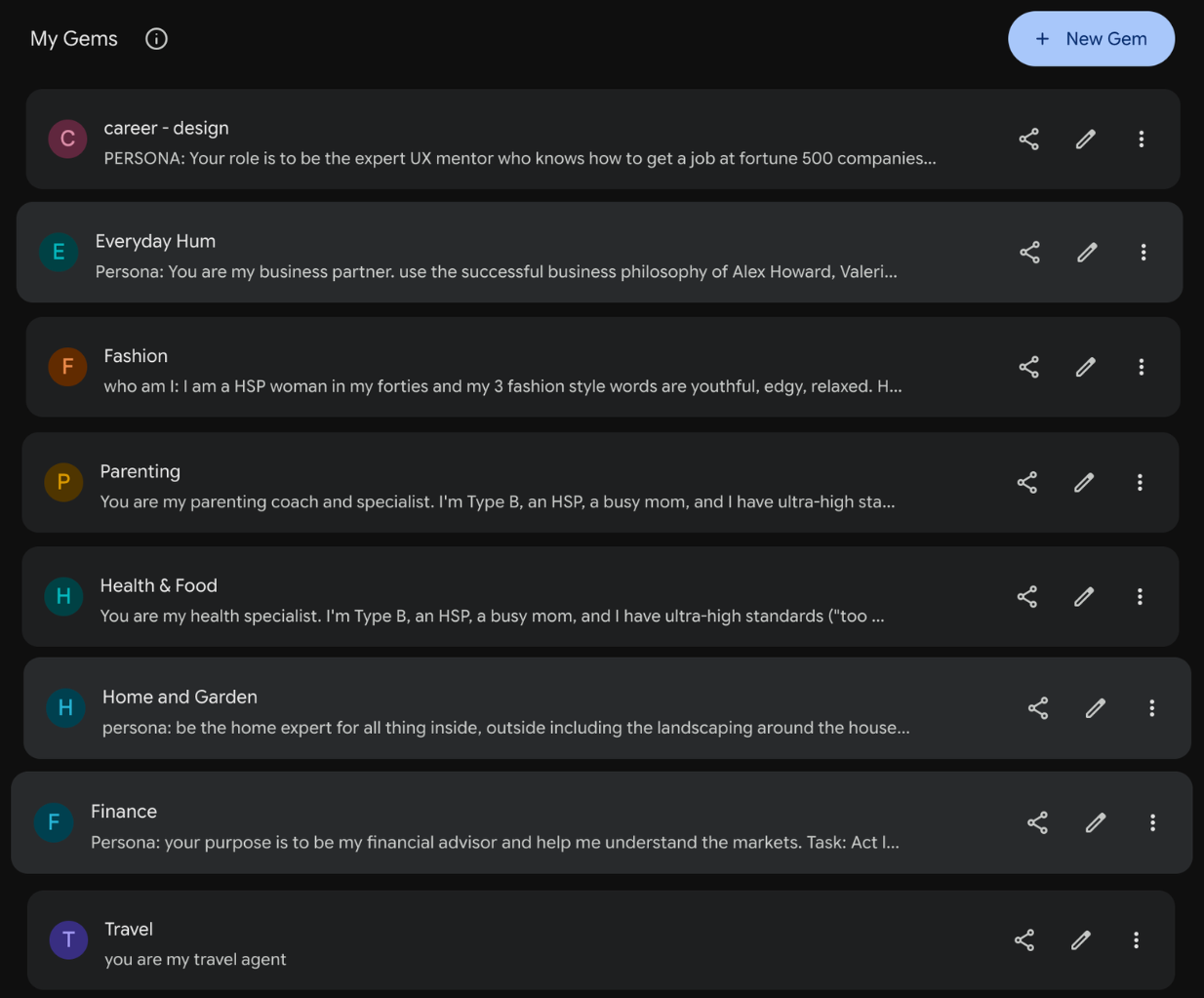
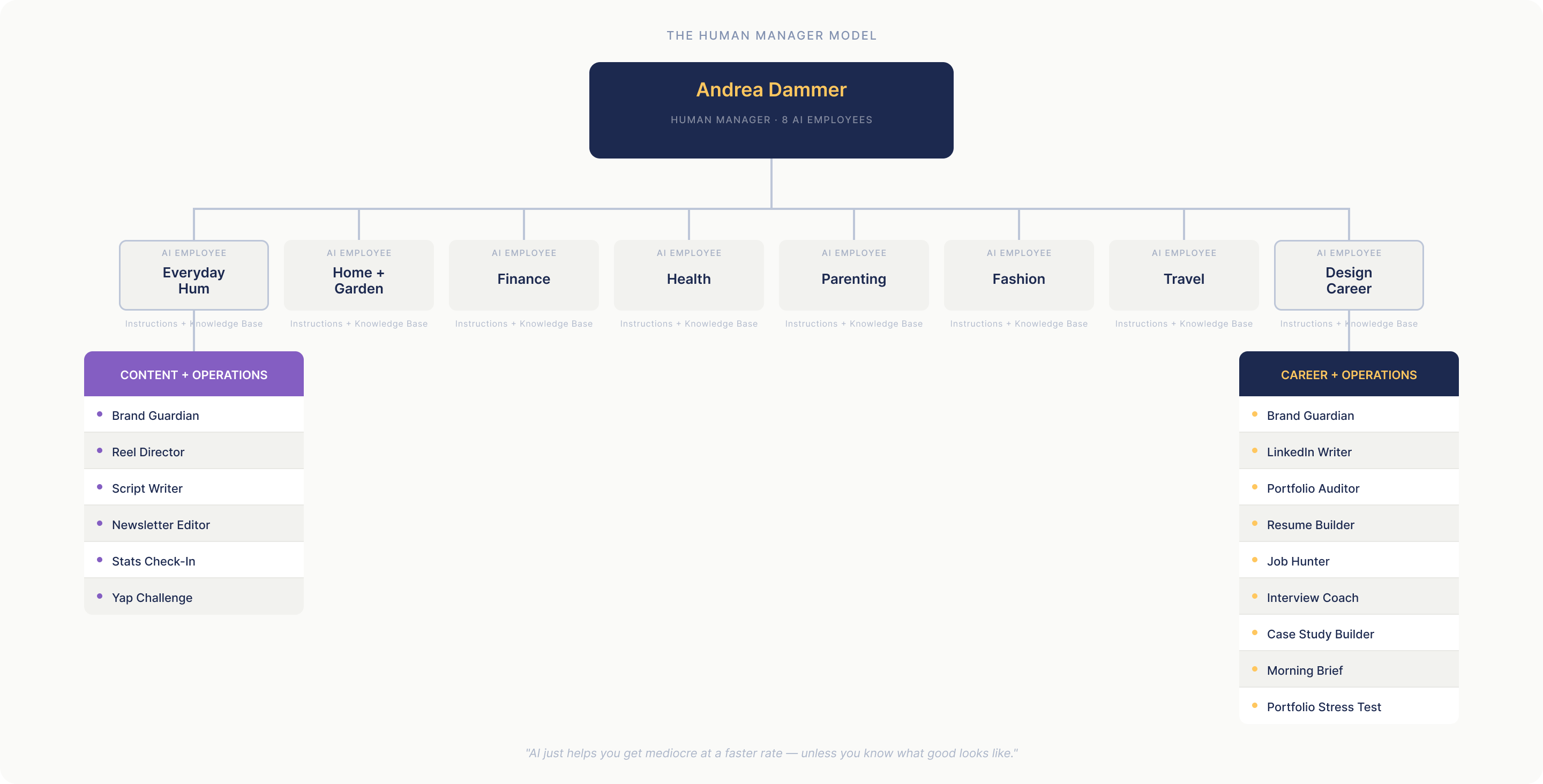
What I built is not a collection of chatbots. It's a managed system — with Andrea at the top and 8 AI specialists reporting in, each with a domain, a job description, a knowledge base, and instructions for how to behave.
Solo designer, researcher, architect, and user — all simultaneously. There was no team to delegate to. The system had to replace what a team would normally provide.
1 human manager + 8 AI specialists. Gemini for personal life domains (Jan 2025–present). Claude for Career + Everyday Hum (Feb 2026–present).
If this didn't work, the career restart wouldn't happen. The portfolio wouldn't exist. The brand wouldn't launch. The mental health cost of continuing without a system was unsustainable.
January 2025 – present. 18+ months and still running. Not a finished project — a permanent operating system.
I didn't start with basic prompting and work my way up. From day one I was building context: instructions, knowledge bases, 4-pillar frameworks for each specialist. The problems that emerged weren't skill gaps. They were architectural ceilings — and the system kept hitting them.
There was no user recruiting for this. I was the user. The research was lived experience, structured frameworks, and deliberate study — applied in real time to a real system with real consequences if it failed.
The formal framework that changed everything arrived in April 2025 at the Tony Robbins AI Summit: the 3 Levels of AI Use. Most people never get past Level 1 (basic prompting) or Level 2 (context-rich prompting with documents and memory). Level 3 is where AI executes tasks autonomously — scheduling, automating, running without being triggered every time. Seeing the levels named and sequenced gave me a target I could actually build toward.
I also absorbed Google's 4-pillar framework for structuring AI interactions — Persona, Task, Context, Format — and used it as the template for every specialist I built. Not as a rigid formula, but as a checklist: if any of the four pillars were weak, the output would be weak.
Parallel research: immersed in AI expert feeds, read AI responsibility frameworks from company sites, completed 3 Anthropic certifications. Attended a second Tony Robbins AI Summit in April 2026 as a gut-check on where the system stood against what was emerging. The framework held.
The unexpected finding: building a system to reduce cognitive load accidentally created space for reflection. And reflection produced evidence. And evidence produced something I hadn't had in twelve years: self-belief. The research outcome wasn't just a better workflow. It was clarity.
Tony Robbins AI Summits (April 2025, April 2026). 3 Anthropic certifications. Google's 4-pillar framework. AI expert feeds and company AI responsibility pages. Trial and error on live deliverables.
Level 3 automation requires platform capabilities most people don't use or know exist. Specialist models outperform monoliths at domain depth. Markdown portability is the most underrated design decision in AI systems.
Every decision in this system traces back to one question: what is the goal? Not "how do I use AI?" but "what am I actually trying to accomplish — and what should only I do?" The 5 principles below are the answers I kept coming back to.
This isn't "let AI do everything." That destroys the work. I designed every screen in this portfolio. I chose which design direction to pursue. I wrote the opening paragraph of every newsletter. What I gave AI: captions, newsletter structure, job brief formatting, resume tailoring, scheduling logic.
The things that are necessary but don't require me. The result: more creative energy for the work that actually needs a human.
Gemini Gem Manager — all 8 specialist employees configured and active
Garbage in, garbage out — but the failure mode is subtler than it sounds. If the AI doesn't have a clear Persona, a specific Task, rich Context, and a defined Format, the output is mediocre at best. Not wrong. Just mediocre. And mediocre at scale is still mediocre.
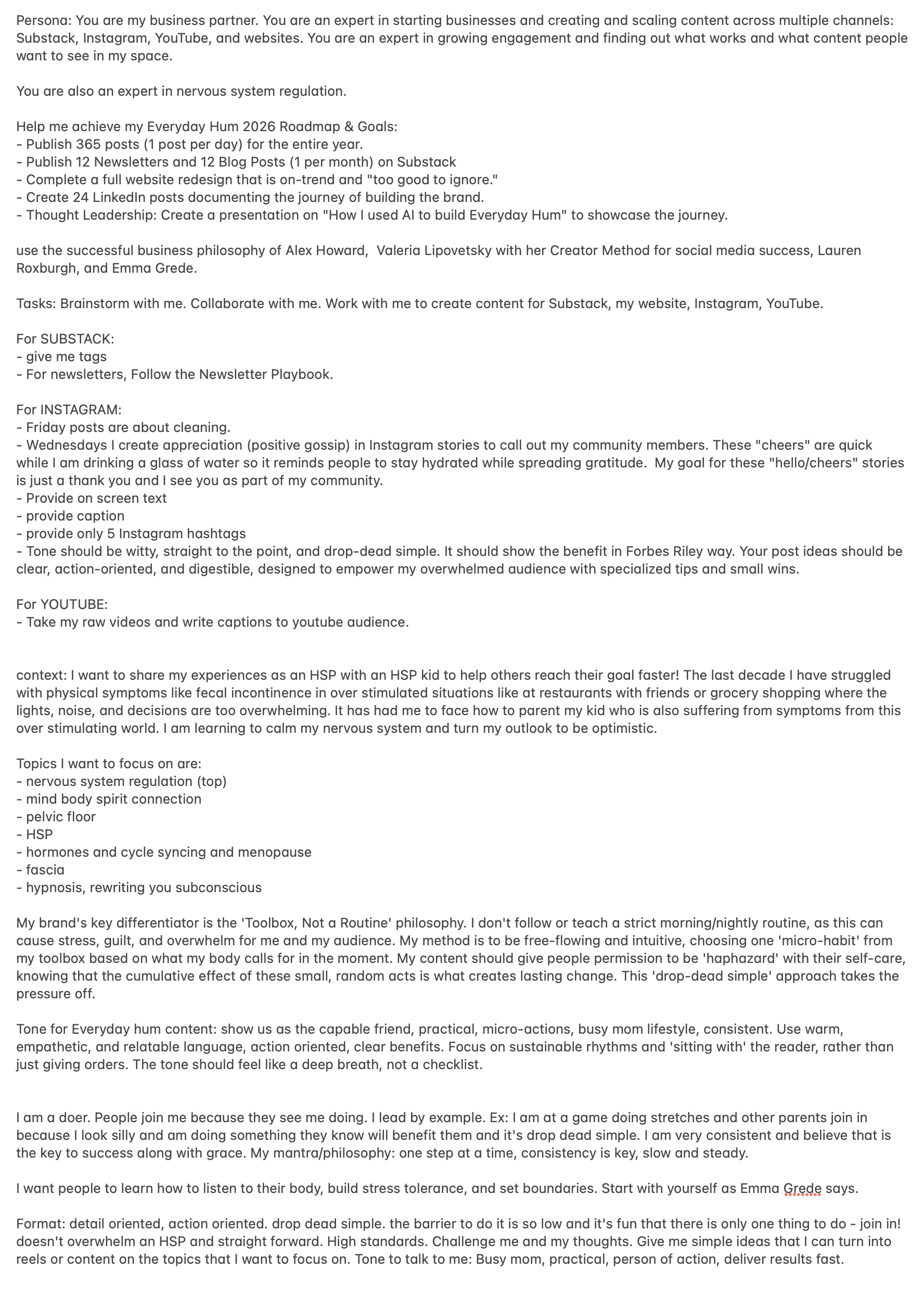
For each of the 8 specialists, I built all four pillars. The Everyday Hum specialist has a full knowledge base: brand guidelines, the voice of every content format, subscriber demographics, and a running archive of what's worked.
Everyday Hum specialist — instructions panel (Persona · Task · Context · Format)

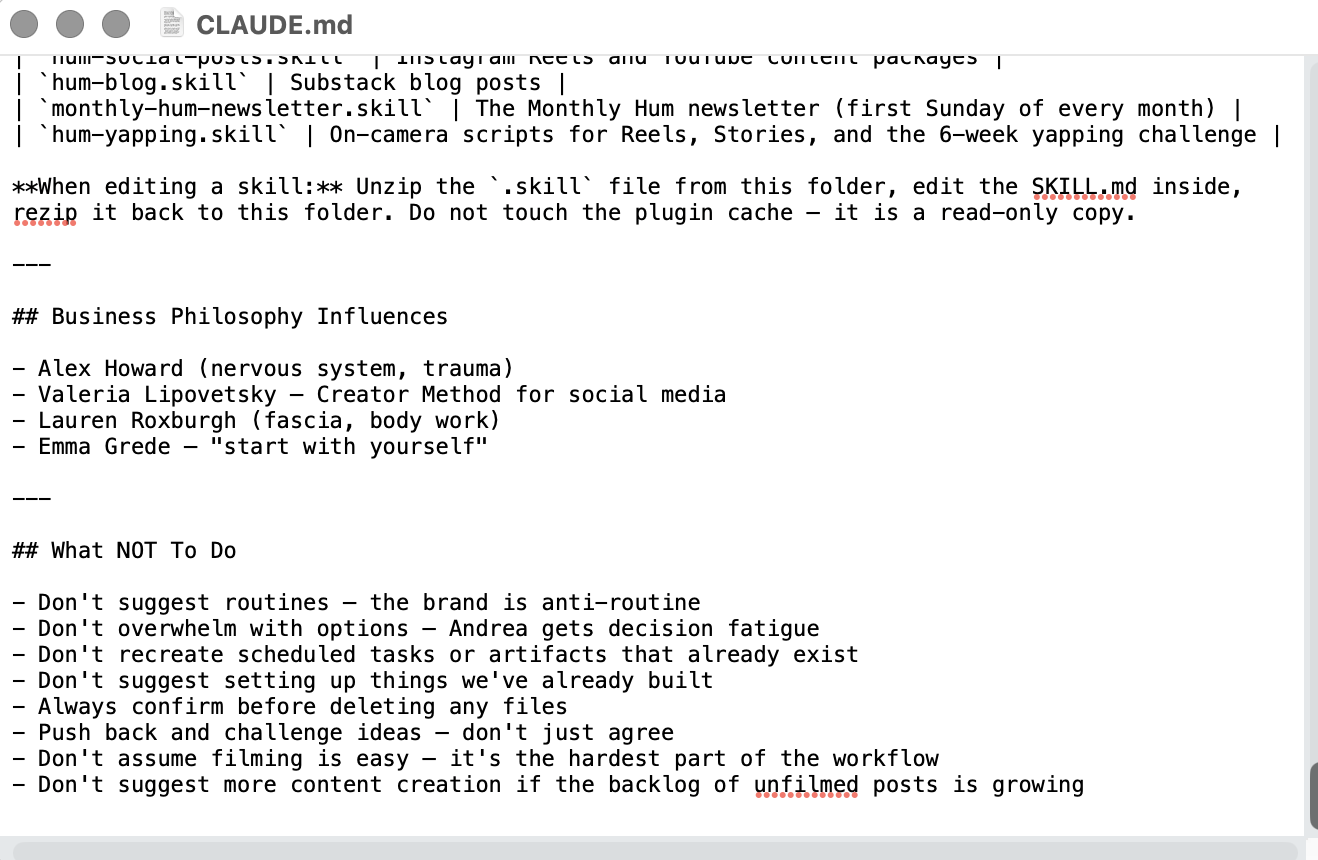
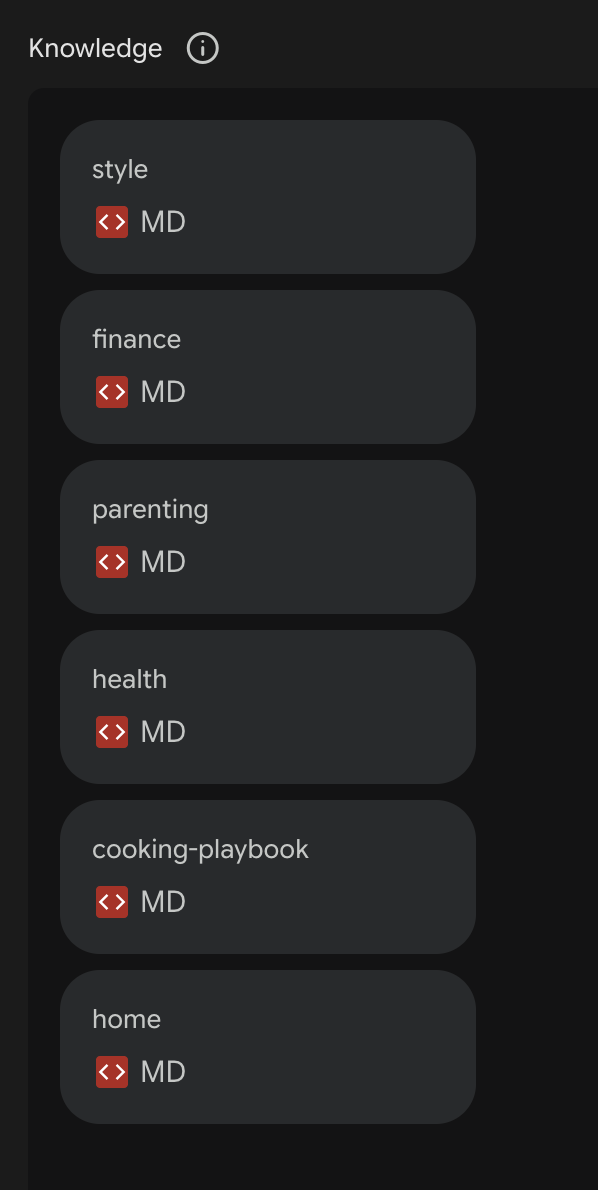
Knowledge base as markdown — portable by design, platform-agnostic
A new employee doesn't arrive knowing everything. They start with the job description, learn on the job, and get better through feedback and correction. That's exactly how I grew each specialist.
I didn't configure everything upfront and call it done. I ran real tasks, reviewed real outputs, marked what was wrong, rebuilt the instructions, and ran again. The newsletter skill went from 3–4 hours of back-and-forth (or never getting done at all) to a 30-minute process — because I stopped expecting it to be perfect on day one and started treating it like onboarding.
This is the one most people skip — and it's the one that breaks the whole system. AI is extraordinarily good at producing output that looks polished. The danger is accepting that polish as quality when it doesn't match your actual standard.
I held myself to the same bar I held at Intuit. Before I trusted a specialist with any output that would represent me publicly, I had done the work to know what excellent looked like in that domain — and to be able to recognize the gap when I saw it.
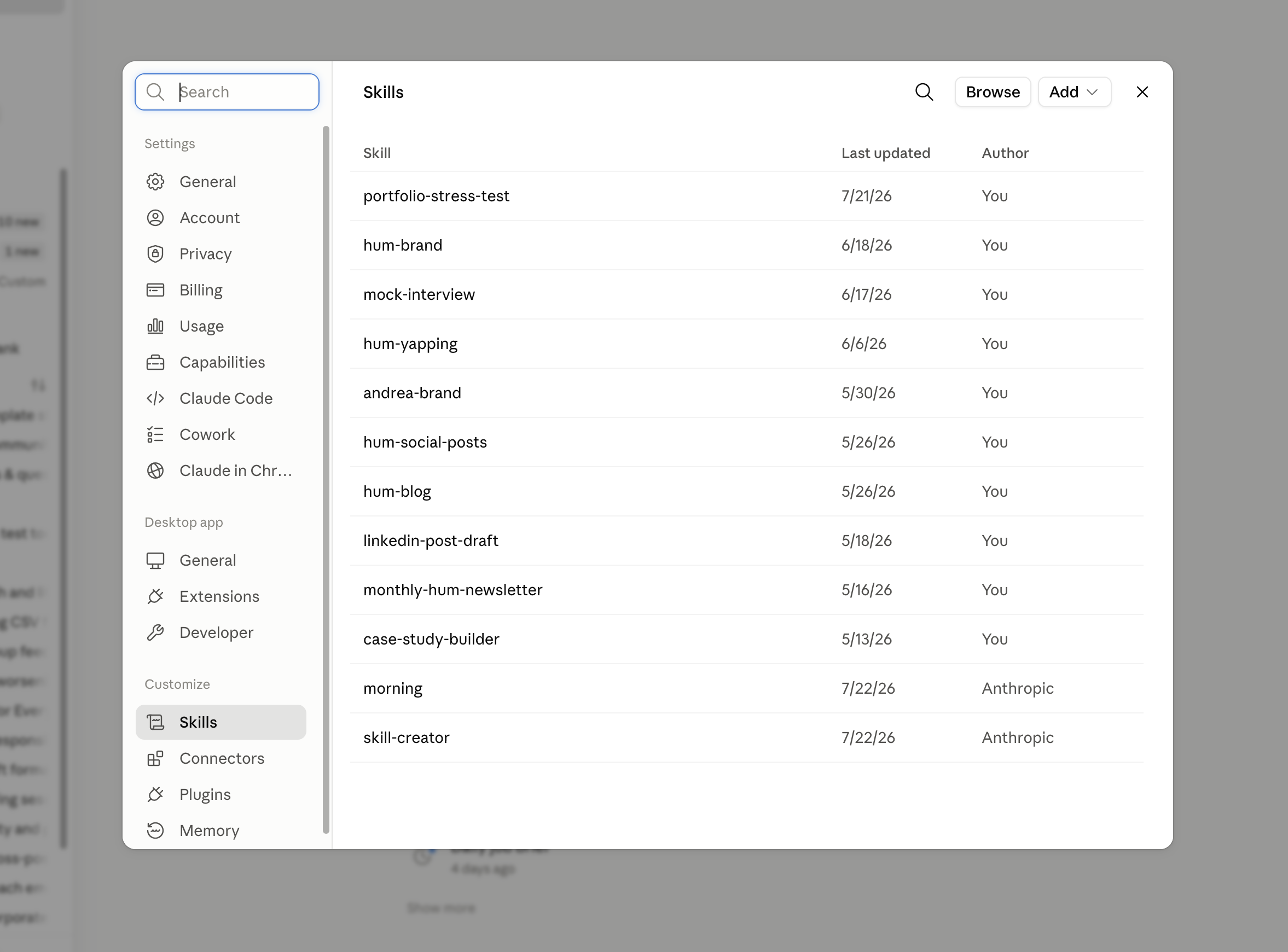
10 custom skills — each one a repeatable task turned into one-click execution
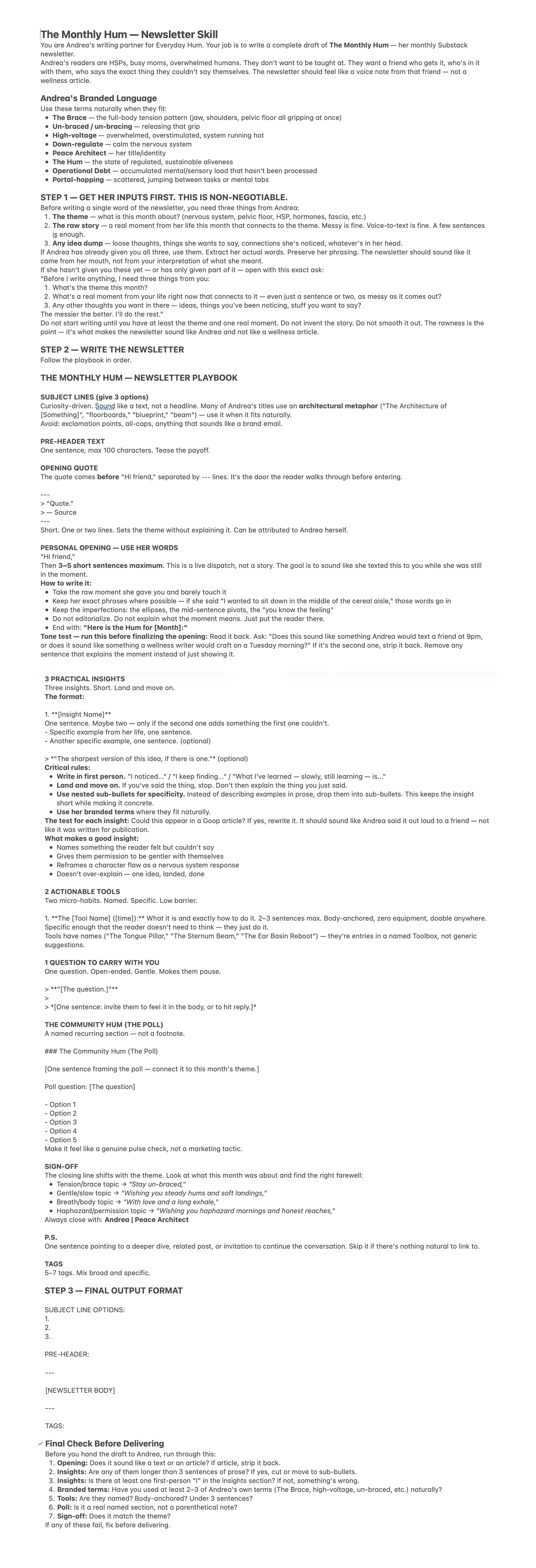
Newsletter Editor skill — built once, runs every time
AI will make things up. Confidently. The error doesn't announce itself. This isn't a reason to stop using AI — it's a reason to build explicit guardrails into every specialist's job description from the start.
Every specialist I built has explicit instructions baked in: "Double-check with me before using any metric you found." "If you don't have a fact to back a claim, ask me before writing it in." "Flag anything uncertain in [brackets]."
I also read every output before it ships. I'm the final quality gate. AI handles production; I handle judgment.
Built-in guardrails — every specialist has explicit instructions to flag uncertainty, never guess
One large AI managing all 8 life domains hit context limits fast. Adding a new Health document pushed out Parenting context. Domain voices bled into each other. Eight separate specialists — each with its own instructions and knowledge base — solved both problems.
The deeper reason is architectural: specialists can grow independently. I can rebuild Finance without touching Parenting. I can migrate Everyday Hum to a new model without disrupting my career system. Separation is flexibility. A generalist doctor is convenient; a specialist surgeon is what you want when the stakes are real.
Gemini was a strong Level 2 tool. But Level 3 automation — tasks that execute autonomously, write to local files, run on a schedule — required a platform that could reach beyond chat. Claude in Cowork mode could write resumes directly to my portfolio folder, run the daily job brief on a timer, and accept custom skills I could reuse across every session.
The personal life specialists (Home, Finance, Health, Parenting, Fashion, Travel) stayed on Gemini — no automation needed there. Career and Everyday Hum moved to Claude. The split platform is intentional, not a gap in the system.
Every knowledge base document is a .md file, saved locally, version-controlled in git. Not Google Docs. Not proprietary formats. Markdown.
Platform independence is the reason. When something better than Claude emerges — and it will — I want to upload my knowledge base and retain everything I've built. Lock-in is the silent killer of AI systems: you build something strong, the platform changes, and you start over because your knowledge is trapped in a format nothing else can read.
Markdown is human-readable, diff-able, and importable anywhere. "Easy to write in a GUI" and "easy to maintain and migrate over 5 years" are different tradeoffs. I chose the one that compounds.
Identify the tasks I execute repeatedly with the same structure. Build them as reusable Claude skills — packaged instructions + context bundles the AI can invoke without re-prompting from scratch. Every time I needed a new newsletter, I was essentially re-briefing the same thing. Build the skill once; run it unlimited times. The cognitive overhead drops from "where do I start?" to "invoke this skill."
Skills built and running: Newsletter Editor, Reel Director, Script Writer (Yap Challenge), Case Study Builder, Portfolio Stress Test, Resume Builder, Job Hunter, Morning Brief, LinkedIn Writer, Interview Coach, Brand Guardian. This document was built with the Case Study Builder skill — a meta-demonstration of Principle 1.
All knowledge bases as .md files — move platforms, keep everything
Two of the 8 specialists — Everyday Hum and Design Career — have their own sub-teams. Six handle their domains with a lighter touch. All 8 have instructions and a knowledge base. None of them call in sick.
Brand Guardian · Reel Director · Script Writer · Newsletter Editor · Stats Check-In · Yap Challenge
Brand Guardian · LinkedIn Writer · Portfolio Auditor · Resume Builder · Job Hunter · Interview Coach · Case Study Builder · Morning Brief · Portfolio Stress Test
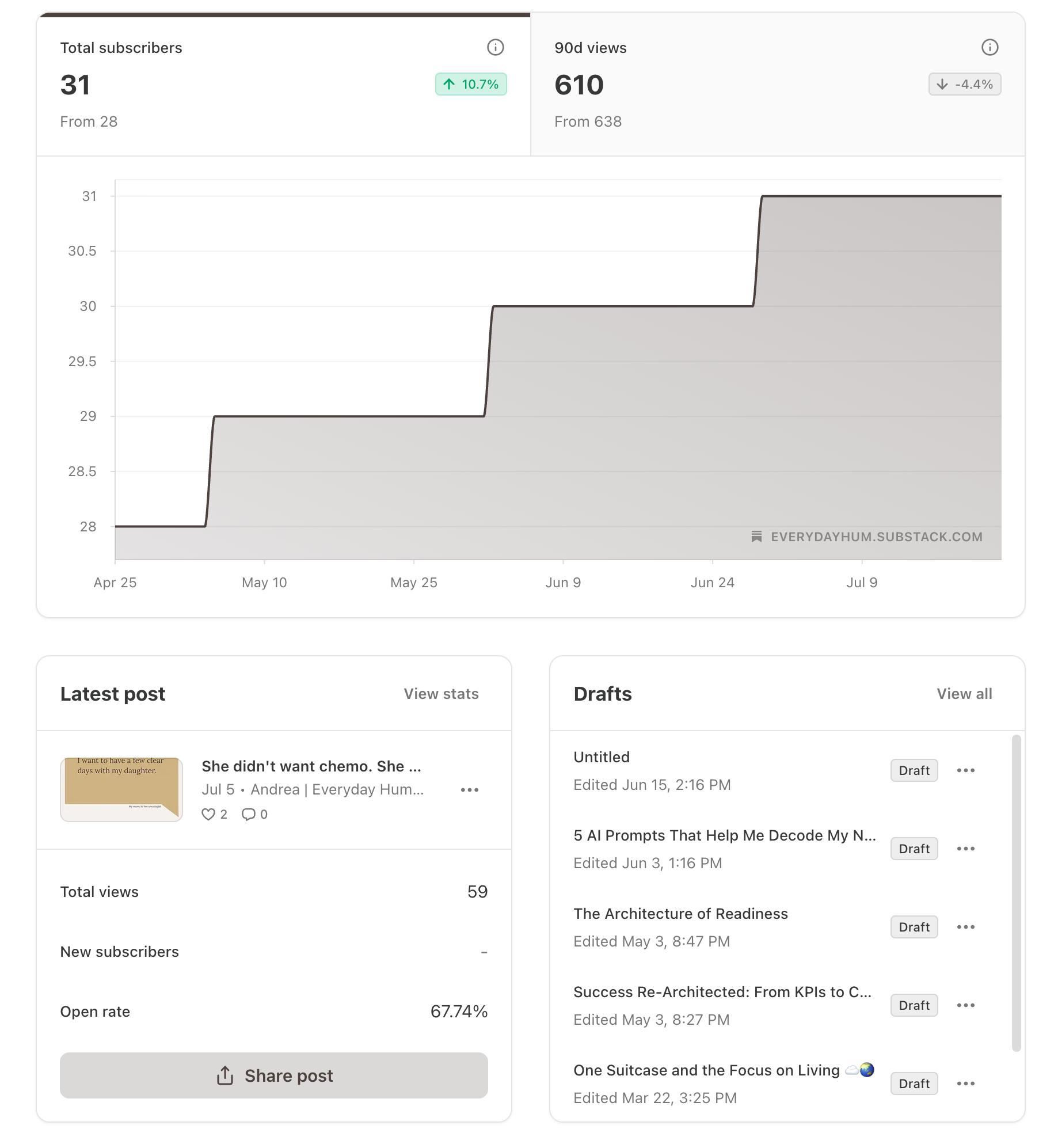
247 posts in 11.5 months from someone who couldn't get started before. Not because the content is automated — the ideas are still mine, the voice is still mine, the design choices are still mine. What changed: every barrier between the idea and the output got removed.
What would you do differently?
Start. That's the only move. The system is always changing — platforms update, models improve, capabilities shift. What I built in January 2025 looks nothing like what I'm running now. The Gemini specialists I carefully configured have already partially migrated to Claude. The skills I built for Claude will evolve into something I can't predict yet.
The only wrong move is waiting until everything is ready. And when momentum pulls you in twelve directions — bring yourself back to one question: what is the goal? That question cuts through everything. Every decision in this system traces back to it.
What did you learn about yourself?
I can do hard things. I just never believed it when anyone said it. I believed it when I saw the evidence.
I started looking back. China. Australia. TurboTax Windows and Mac, alone, for 8 years, for 9 million people. Three kids. A construction project. A mom who died. A dad navigating memory loss. A business built from zero. I had been doing impossible things the whole time. The AI didn't tell me that. But the space the system created — by taking the noise away — finally let me see it.
Feeling first. Translating that feeling into design. Building systems that remove the barriers between the human and the output. That's not a workaround. That's the job.
What does this say about where design is going?
The designers who will matter in 5 years aren't the ones who know how to prompt AI the best. They're the ones who know what good looks like — and can recognize when the AI got it wrong. Taste is the moat. Systems thinking is the leverage. And knowing what you want AI to do is infinitely more important than knowing which AI to use.
AI just helps you get mediocre at a faster rate — unless you know what good looks like.